
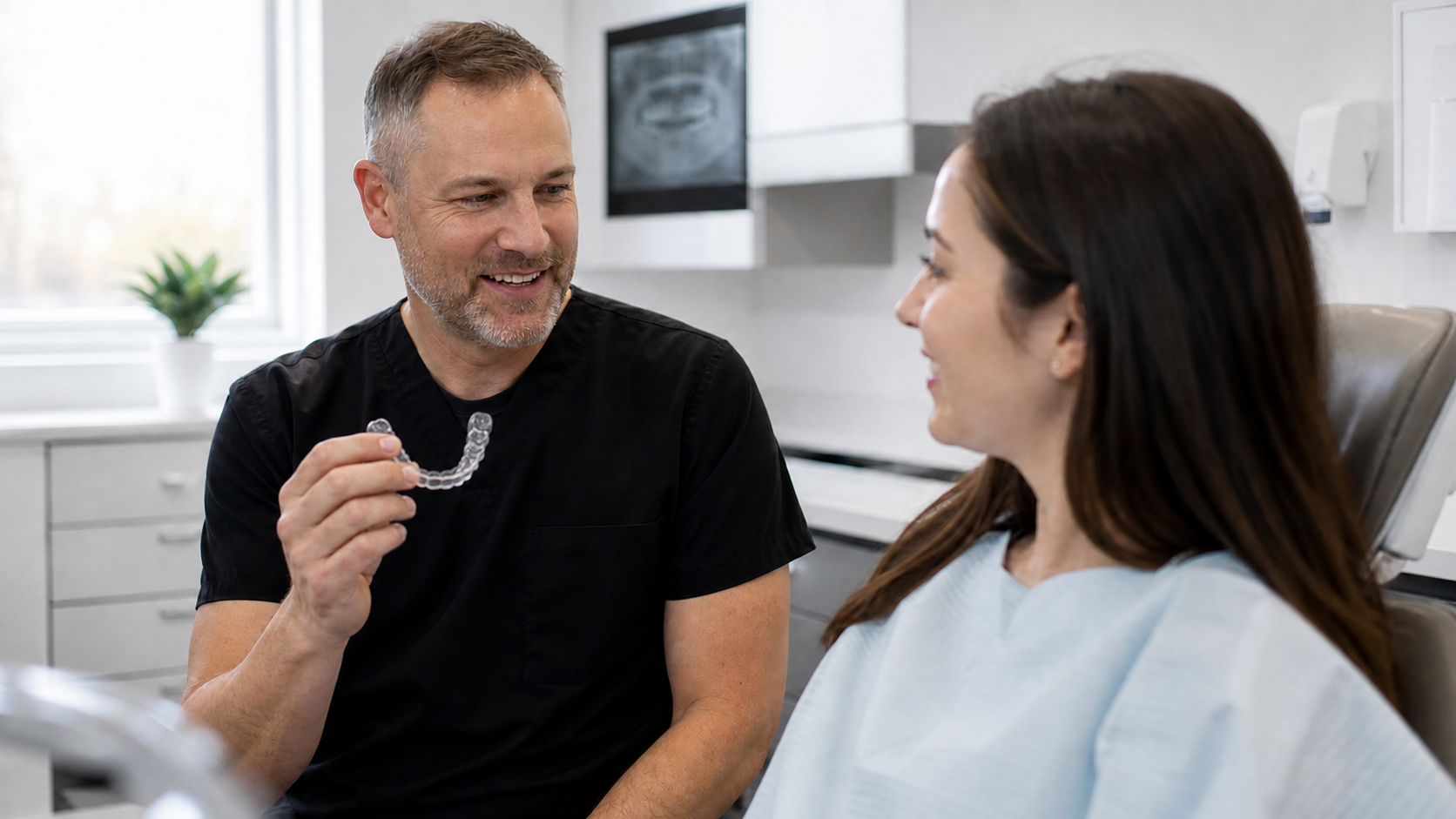
Can Invisalign fix an underbite? Often, yes, when the underbite comes from the position of the teeth rather than the size of the jaw. At Bayly Dental Clinic in Pickering, Invisalign is used for bite alignment issues, while braces or early interceptive treatment may suit skeletal cases. An in-person assessment shows which type you have.
What Aligners Can and Cannot Do for an Underbite
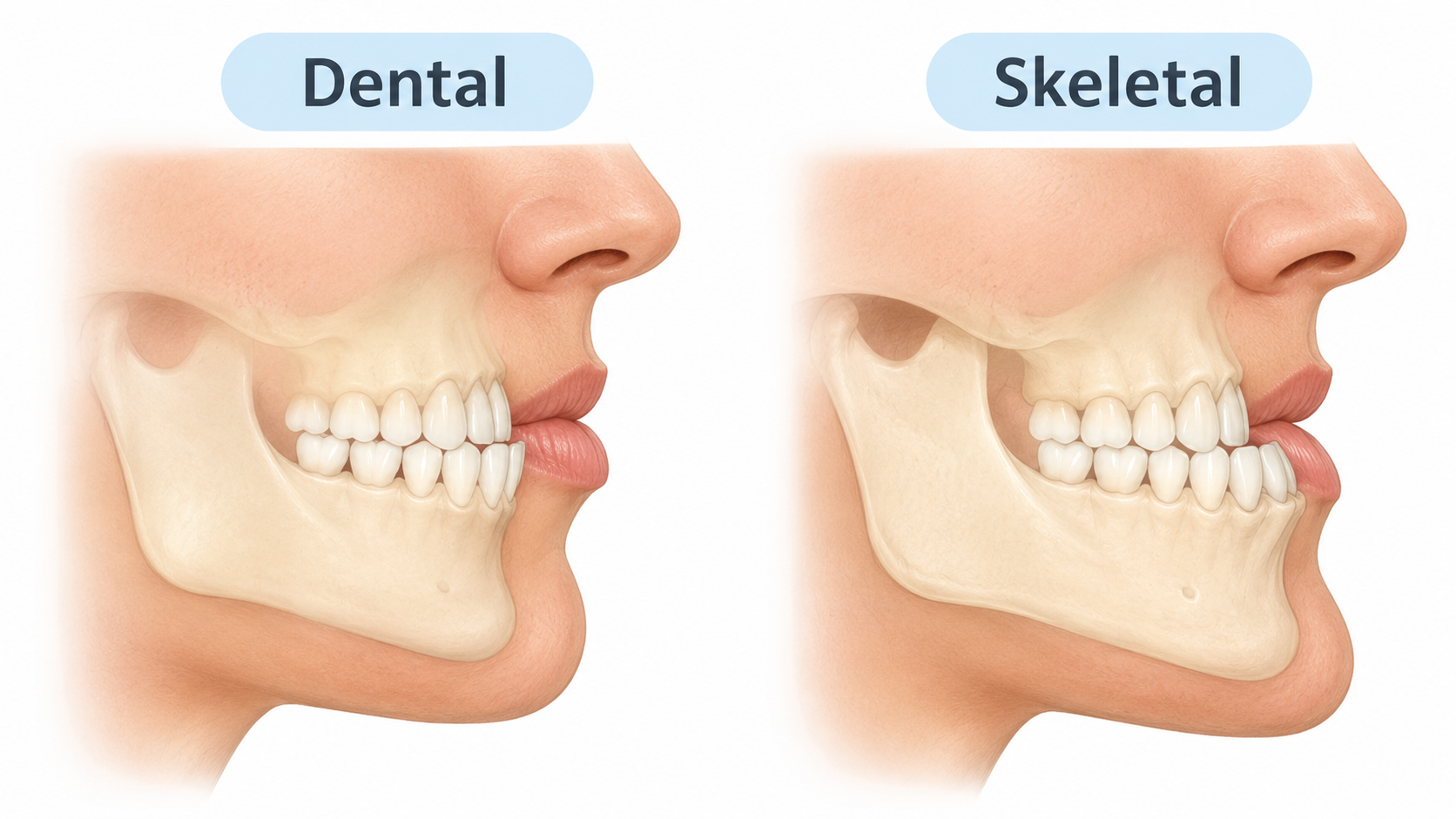
- The cause decides the answer. A dental underbite (tipped teeth) is very different from a skeletal one (jaw size or position)
- Mild to moderate dental underbites are the cases most likely to respond to clear aligners
- Skeletal underbites in adults may need braces, or orthodontics combined with jaw surgery, rather than aligners alone
- Children have an advantage. Early interceptive treatment, typically between ages 7 and 10, can guide jaw growth while it is still happening
- Results depend on wear. Aligners only move teeth while they are in your mouth, so consistent daily wear matters
An underbite is one of the bite problems people most often assume needs metal braces, or even surgery. Sometimes it does. Often it does not, and the difference comes down to what is actually causing the lower teeth to sit in front of the upper ones.
This guide explains how underbites are classified, which ones clear aligners can treat, where braces or early treatment make more sense, and what an assessment for an Invisalign underbite case looks like for patients in Pickering and Ajax.
What Is an Underbite?
An underbite is a type of malocclusion, which is the clinical term for teeth that do not fit together properly. According to the Canadian Dental Association, an underbite occurs when the upper teeth fit inside the arch of the lower teeth.
In everyday terms, when you close your mouth, your lower front teeth sit in front of your upper front teeth instead of behind them. Dentists also call this a Class III bite.
Underbites range from barely noticeable to very pronounced:
- Mild: the front teeth meet edge to edge, or the lower teeth sit only slightly forward
- Moderate: the lower teeth clearly overlap the upper teeth from the front
- Severe: the lower jaw projects forward and the face looks noticeably longer in the lower third
Why an Underbite Is Worth Treating
An underbite is not only a cosmetic concern. When the teeth do not meet the way they should, the bite force is distributed unevenly. Over time this can lead to:
- Uneven wear or chipping on the front teeth
- Difficulty biting into foods with the front teeth
- Strain on the jaw muscles and joints
- Changes in speech for some people
- Teeth that are harder to keep clean where they crowd or overlap
Dental vs Skeletal: The Difference That Decides Your Options
Every underbite falls into one of two broad groups, and some people have a mix of both. Working out which group you are in is the first job of any orthodontic assessment.
Dental Underbites
A dental underbite happens when the jaws themselves are a normal size and in a normal position, but the teeth are angled the wrong way. The upper front teeth may tip backward, the lower front teeth may tip forward, or both.
Because the problem sits in the teeth, moving the teeth can correct it. This is the type of underbite where clear aligners have the strongest case.
Skeletal Underbites
A skeletal underbite comes from the bones. The lower jaw may be larger or further forward than the upper jaw, or the upper jaw may be underdeveloped or too narrow.
Moving teeth can disguise a mild skeletal underbite, but it cannot change the size of a jaw in an adult whose growth has finished. Skeletal patterns often run in families, and habits such as thumb-sucking or tongue-thrusting in childhood can also influence how the jaws develop.
So, Can Invisalign Fix an Underbite?
For many people, the honest answer is yes, within limits. Invisalign moves teeth in small, planned stages, and those movements can bring the upper front teeth forward and the lower front teeth back until they meet in a healthier position.
At Bayly Dental Clinic, Invisalign treatment is used for adults seeking discreet orthodontic treatment, teens looking for an alternative to traditional braces, and patients with crowded teeth, gaps, bite alignment issues or orthodontic relapse.
When Aligners Are Likely to Work
- The underbite is mainly dental rather than skeletal
- The overlap is mild to moderate
- The patient is willing to wear the aligners consistently every day
- Small tooth-coloured attachments can be placed where extra grip is needed
When Aligners Alone Are Not Enough
Clear aligners are not suitable for complex orthodontic cases. A pronounced skeletal underbite in an adult usually needs a different approach, which may be braces for more precise, controlled movement, or orthodontic treatment combined with jaw surgery.
These limitations are discussed before treatment starts at Bayly Dental Clinic, so you know what aligners can realistically achieve for your bite before you commit to anything.
How Invisalign Treatment for an Underbite Works
Invisalign underbite treatment follows the same structure as any other Invisalign case. What changes is the planning, because bite correction involves moving both arches in relation to each other.
At Bayly Dental Clinic in Pickering, treatment is typically structured like this:
- Initial consultation and digital assessment. Your teeth, bite and jaw position are reviewed and recorded.
- Custom aligners provided in stages. Each set moves the teeth a small, planned amount.
- Regular follow-up visits. Progress is monitored in person throughout treatment.
- Refinements if needed. If treatment goals evolve, additional aligners can be made.
- A retention plan. This is discussed once treatment is complete, so the corrected bite stays where it should.
How Long Does It Take?
Invisalign treatment at Bayly Dental Clinic typically takes 4 to 24 months. Where your case falls in that range depends on how far the teeth in each arch need to move.
Treatment time varies with case complexity, and patient compliance affects how long it takes. Refinements may also extend the timeline. Your expected timeline is reviewed with you before treatment begins.
What Daily Wear Looks Like
Aligners require consistent daily wear. They come out to eat and to brush, then go straight back in. Leaving them out for long stretches is the most common reason a case falls behind schedule.
Temporary discomfort can come with each new set of aligners, as the teeth begin to move. It is a sign of pressure doing its job, and it is temporary.
Can Invisalign Fix an Underbite in Children?
Children are in a different position from adults, because their jaws are still growing. That growth can be guided, which is why skeletal underbites are often easier to address in childhood than later in life.
At Bayly Dental Clinic, early interceptive treatment is most commonly recommended for skeletal bite issues such as crossbite, underbite or a narrow upper jaw. The recommendation is based on a child’s dental development, typically between ages 7 and 10.
What Early Treatment Can Involve
Depending on the child’s needs, early interceptive orthodontics at Bayly Dental Clinic may use:
- Fixed palatal expanders to widen the upper jaw
- Functional appliances or space maintainers to hold room for adult teeth
- Partial braces limited to the front teeth
- Specialized pediatric clear aligners, such as Invisalign First
The appliance is chosen based on the child’s comfort level, maturity and specific clinical needs. If clear aligners are used, the child must wear them 20 to 22 hours a day, so parental support makes a real difference.
Why Waiting Can Matter
When a skeletal underbite is not addressed during growth, the jaw can continue to grow unevenly, affecting the child’s facial profile and bite function. In some cases, a permanent skeletal problem may eventually require jaw surgery in adulthood.
That does not mean every child with an underbite needs treatment straight away. It means an assessment during the growth years gives you more options.
When Braces May Be the Better Choice
At Bayly Dental Clinic, traditional braces in Pickering are most commonly recommended for bite issues such as overbite, underbite or crossbite, for moderate to severe crowding or spacing, and for tooth alignment problems that require precise, controlled movement.
Braces are fixed to the teeth, so they work around the clock without relying on the patient to wear anything. For a more complex underbite, that constant, precise control can be the deciding factor.
If you are not sure which way your case leans, our guide to what to expect at your first braces appointment walks through how braces treatment begins.
How Bayly Dental Clinic Assesses Your Underbite
You cannot tell whether an underbite is dental or skeletal by looking in the mirror. An assessment can.
For patients in Pickering, the process starts with a consultation and digital assessment. Orthodontic planning can involve standard records such as photos, impressions and X-rays, digital impressions, and imaging used to assess jaw position and tooth movement. The technology is selected based on your age, case complexity and monitoring needs.
From there, you will hear which options suit your bite, what each one can realistically achieve, and how treatment would be overseen. Your orthodontic insurance benefits can be reviewed, including what may be covered and what may be out of pocket, and financing options may be available. A personalized estimate is provided after the assessment.
Once treatment is complete, keeping the result matters as much as achieving it. Read more about keeping your results after orthodontic treatment.
Underbite Questions Patients Ask Before Choosing Aligners
Wondering Whether Aligners Can Correct Your Bite?
Still not sure whether your underbite is the kind aligners can fix, or whether braces or early treatment would serve you better? A single assessment answers that question properly.
- Invisalign treatment is provided by Dr. Tamara Kamaluldeen, an Invisalign-certified dentist, with cases monitored through regular in-person visits
- Your treatment oversight and any limitations are explained during the consultation, before anything begins
- Invisalign, traditional braces and early interceptive orthodontics are all offered at one clinic in Pickering, so the recommendation is based on your bite, not on a single option
To book an Invisalign in Pickering consultation, call Bayly Dental Clinic or visit us at 1635 Bayly St, Building F, Unit 3, Pickering, ON L1W 3N2.

Does Dental Implant Surgery Hurt?
Discover the clinical facts about dental implant comfort. Learn why the surgical procedure is pain-free and get expert tips for a fast, smooth recovery.

Tooth Extraction for Kids: A Parent's Complete Guide
A practical guide to tooth extraction for kids, including preparation, pain management, treatment, recovery and when to contact the dentist.